
Hello, singers! If you are studying vocal technique, you have surely heard the famous phrase: "Breathe from your diaphragm!"But what does that actually mean? Is there really only one correct way to breathe for singing?

The truth is, the human vocal apparatus was not originally designed to produce art, but rather for basic survival functions, such as protecting our airways. Singing is a wonderful evolutionary adaptation that requires the coordination of almost our entire body.
To help you understand this process in the most educational way possible, we are going to explore how breathing works from the perspective of different experts: from pure anatomy, to training for rockers, and respiratory rehabilitation.
Let's also clarify that this is a topic of debate to this day. That is why we are going to talk a bit about the different points of view, so you can ultimately draw your own conclusion.
1. The Anatomical Foundation: The "Bellows" of the Voice
Based on the studies of Dr. Begonya Torres
Dr. Torres tells us that to produce voice, our body uses three systems, which she defines as follows: the bellows (lungs and respiratory muscles), the vibrator (vocal cords), and the resonators (mouth, pharynx, and nasal cavities).
She explains that, classically, there are three types of breathing, but the optimal one for singing is diaphragmatic or costodiaphragmatic breathing..
How does it look visually? Imagine a syringe: when you pull the plunger down, liquid enters. The diaphragm is our plunger. When we inhale, the diaphragm contracts and moves downward, pushing the abdominal organs outward (which is why our "belly sticks out").
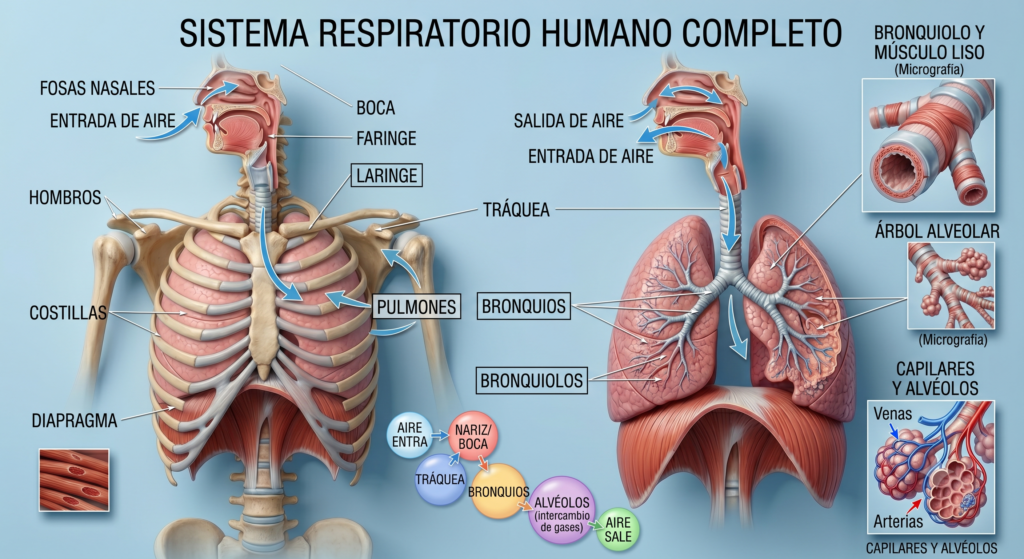
The Famous "Appoggio" or "Support": In normal breathing, releasing air is a passive process. But in singing, exhalation must be activeThis is where the abdominal muscles come into play. When singing, the abdominals contract and act upon the diaphragm (the plunger), making it rise in a controlled manner to send the air toward the vocal cords with the exact amount of pressure. This teamwork is the true "vocal support."
2. Maximum Potential Breathing and the "Sensation of Inhalation"
The perspective of vocal coach Jaime Vendera
If you want to hold endless notes and sing with great power, Jaime Vendera proposes a more expansive approach called "Maximum Breathing Potential.".
For Vendera, limiting oneself to only breathing with the abdomen means filling just a fraction of your lungs
The Water Vase Analogy: Imagine your body is a vase. When you pour water, it fills from the bottom up. Vendera suggests that singers combine diaphragmatic and thoracic breathing: first expand the abdomen, then expand the ribs and back (thanks to the intercostal muscles), and finally allow the chest to expand.
Vendera’s Secrets for Students:
- Keep the ribs expanded: When releasing air while singing, your stomach will want to contract and your ribs will want to collapse. Don't let the ribs win! Keeping them open slows down the air release.
- The Sensation of Inhalation: This is his master trick. While singing (exhaling), pretend you are inhaling.This removes excessive pressure from the stomach and helps the diaphragm relax slowly, doubling the amount of time you can hold a note.
- For more power: Instead of squeezing the stomach inward or outward, Vendera (citing Elizabeth Sabine) recommends pushing the stomach muscles directly downward (as if you were using the bathroom) when you need high power or very high notes. This creates the necessary energy without sending an excess of air pressure that could damage the vocal cords.
3. "Respiratory Coordination" (SIMBIC): The Power of Non-Forcing
The vision of researcher Carl Stough
Carl Stough—a pioneer in respiratory mechanics, and I must admit, the person with whom I personally share the closest views on this "art of breathing"—trained pulmonary disease patients as well as Olympic athletes and singers. He has a very different vision. For Stough, the traditional concept of "belly breathing" or using voluntary muscles to force the diaphragm is a serious mistake.

The diaphragm is involuntary: Stough reminds us that the diaphragm cannot be controlled at will; it functions in response to air pressure and in tandem with other muscles. Trying to pump air by forcibly pushing the belly exerts excessive pressure on the diaphragm, potentially weakening it and causing vocal or health problems.
The key is Synergy: Stough discovered Respiratory Coordinationwhich is the individual, natural pattern in which all respiratory muscles work as a team, without placing the burden on just one.
Stough’s Approach for Singers:
- Sound is the diaphragm’s gym weight: To strengthen the diaphragm, Stough uses phonation (sound). When singing or counting numbers out loud, the vocal cords offer an "isometric resistance" to the air. This gentle resistance is what truly develops the respiratory muscles safely.
- Exhalation is the most important part: Many singers feel they lack air and try to inhale more, but in reality, the feeling of suffocation happens because they haven't emptied their lungs of stale air. Focus on a long, relaxed exhalation; the inhalation will happen automatically and naturally.
4. The Stage Fright Bonus
From the clinical perspective of Dr. Hidetaka Hamasaki
Do you get very nervous before going on stage? Dr. Hamasaki explains that slow, deep diaphragmatic breathing has a direct impact on the nervous system. By lowering your breathing rate, you activate the vagus nerve (the parasympathetic system), which automatically reduces stress, anxiety, and even blood pressure. Your breath not only fuels your voice, it calms your mind!
Comparison Chart: Breathing Schools for Singing
To help you visualize it better, here is a summary of the three main perspectives on how to approach your instrument:
| Concept | Dr. Begonya Torres (Anatomical/Classical Approach) | Jaime Vendera (Rock/Power Approach) | Carl Stough (Holistic/Coordination Approach) |
|---|---|---|---|
| Ideal Inhalation | Descent of the diaphragm, expansion of the lower thorax and upper abdomen. | Filling the body like a vase: abdomen, then ribs, then chest. | Automatic inhalation as a natural response to having emptied the lungs. |
| Air Control (Support) | Action of the abdominal muscles pushing the viscera and the diaphragm upward. | Keeping ribs open; pushing the stomach downward for power. | Relaxed "coordination" of all muscles; no forcing with the abdominals. |
| Exhalation (Singing) | Must be consciously controlled to overcome the resistance of the vocal cords. | Using the "Sensation of Inhalation" (thinking you are taking in air while singing). | Relaxed effort; using the actual sound of the voice as a natural resistance to strengthen the system. |
Conclusion: What Should You Do?
As a voice student, you will notice that although the words change, the goal is the same: to achieve a constant airflow without tensions that block your larynx..
Experiment with your body. Feel how your body expands as Torres says; try keeping your ribs open and thinking of Vendera's "sensation of inhalation" so you don't run out of air. But always do so keeping Stough's golden rule in mind: you must never force your body artificially or create unnecessary tension.Breathing, even in the virtuosity of singing, must stem from natural coordination. Breathe, relax, and go sing!

